A casino night is one of the few corporate events where guests stop checking their phones. The games give people a reason to talk to someone they have never met, and the room fills with the kind of noise a good party makes. It is also one of the easier events to get wrong. Too few tables and half your guests stand around watching. No dealers and the games stall. Bad lighting and a ballroom still looks like a ballroom.
This is what we have learned producing casino nights across Florida: what the games need, how many tables your headcount requires, what moves the price, and how to run it as a fundraiser.
What a casino night is and why companies run them
A casino night is an event where guests play real casino games with chips instead of money. Blackjack, roulette, craps, and poker, run by dealers, on full-size tables. Nobody cashes out. Guests usually are given a set number of chips, play for two to three hours, and trade whatever they have left for raffle entries or prizes.
Companies run them because they solve the problem every corporate party has: getting people to mix. A seated dinner sits people with the colleagues they already know. A cocktail hour produces the same six conversations. A blackjack table puts a VP next to a new hire and gives them something to do together.
They work for holiday parties, fundraisers, client appreciation nights, and the reception half of a conference. The format flexes. The tables do the work.
See how we build a casino floor
The games guests expect
Four games carry a casino night. You do not need all of them, but you should know what each one does to a room.
Blackjack
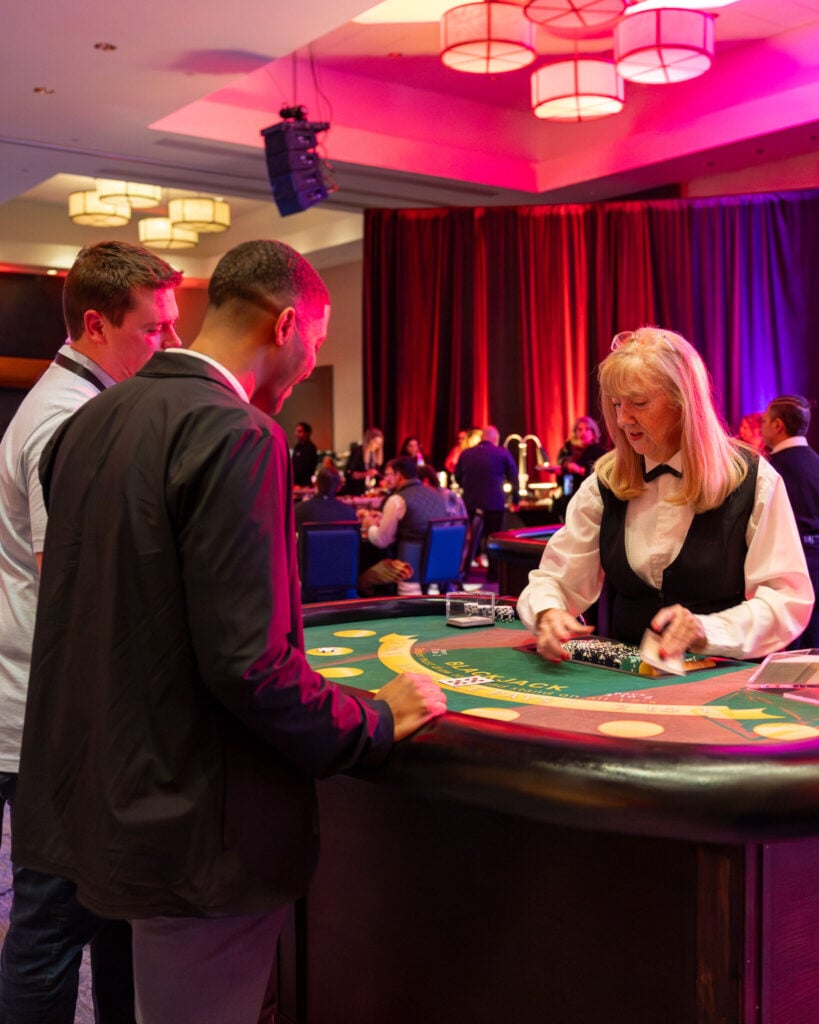
The workhorse. Easy to learn, fast to play, and it seats seven. Most guests know the rules or can learn them in one hand. If you only run one game, run this one. Plan for blackjack to be your highest-traffic table all night.
Roulette
The spectacle. The wheel draws a crowd, and people who do not want to play still gather to watch. One roulette table changes how a room looks in photos. It also absorbs more guests than its seat count suggests, because standing and betting works.
Craps
The loud one. Craps is where the noise comes from, and noise is what makes a party feel alive. It has the steepest learning curve, so a good dealer matters more here than anywhere else. Put it where the energy should be, not next to the speeches.
Poker
The slow burn. Poker players sit down and stay. That is a feature if you want a serious corner and a problem if you need tables to turn over. One or two tables, no more, unless your crowd asks for it.
See the tables and equipment we bring
How many tables you need for your headcount
This is the question that decides whether your casino night works.
The rule most planners use: plan for roughly 60 to 70 percent of your guests to play at any one time. The rest are eating, drinking, or watching. A blackjack table seats about seven. A roulette table handles eight or more with standing players. A craps table takes twelve to fifteen. Poker seats eight.
Run that math, at roughly one table for every eight to ten players, and a 100-person event needs six to eight tables. A 200-person event needs twelve to fifteen. A 300-person event needs eighteen or more, and at that size the mix matters as much as the count.
Two things the math misses. First, tables need space around them, not just floor area. A table crammed against a wall plays badly. Second, your event length changes the count. A two-hour casino night needs more tables than a four-hour one, because everyone plays at once instead of drifting through.
The honest answer is that the right count depends on your room, your headcount, and how long the tables are open. That is a ten-minute conversation, not a formula.
Tell us your headcount and venue and we will scope it
What it costs and what drives the price
Casino night pricing scales with three things: table count, dealer hours, and the room.
Table count
The biggest lever. Each table carries the equipment, the dealer, and the floor space. Going from six tables to twelve roughly doubles the core cost. This is why the headcount math above matters before anyone quotes you.
Dealer hours
Dealers are priced by the hour, and they arrive before your guests do. A four-hour party is not four hours of dealer time. It is setup, play, and breakdown. Longer play windows cost more, but they also let you run fewer tables, so the two levers trade against each other.
The room
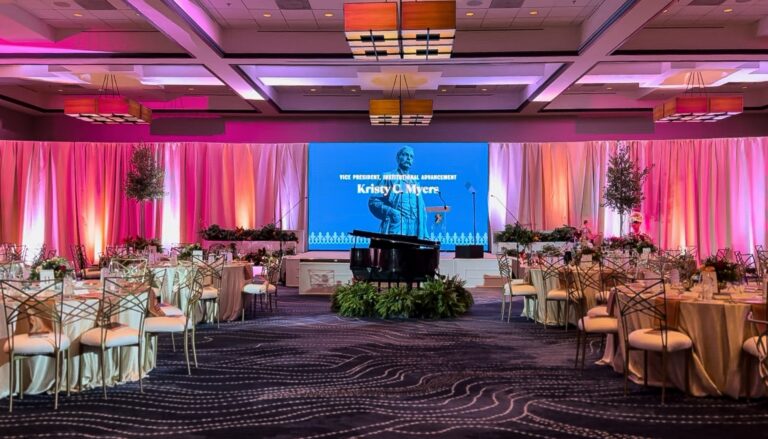
Lighting, staging, and décor are what turn a ballroom into a floor. This is optional and it is also the difference between a party with tables and a casino night. A room with the right lighting reads as a casino in every photo your team posts afterward.
What we do not do is quote a flat rate. A 60-person client appreciation night and a 400-person holiday party are different events with different answers. We scope it in a short call and send a written proposal, so you see the full number before you commit.
Get a written casino night proposal
How to run it as a fundraiser
Casino nights are one of the best fundraiser formats, because the mechanics of the game are already a donation mechanic.
The standard structure: guests buy in for a set chip stack, and the buy-in is the donation. Play runs for two to three hours. At the end, guests trade their chips for raffle tickets, and the raffle drives a second round of giving. Add a live auction between the play window and the raffle and you have a full program.
Three things that make the fundraiser version work. Cap the buy-in so nobody feels priced out and offer a rebuy so the enthusiastic can give more. Make the prizes worth playing for, because the raffle is where the second ask happens. And keep the program short. The tables are the event; the speeches are the interruption.
We have produced fundraiser events across Florida, including for the Tom Coughlin Jay Fund and American Cancer Society.
See our fundraiser and gala work
Booking the room, the tables, and the dealers as one job
Here is where most casino nights go sideways. The tables come from one vendor, the lighting from another, the sound from a third, and nobody owns the room.
The tables show up at four. The lighting crew shows up at five and cannot set around the tables that are already set. The sound tech needs power from the same spot as the roulette wheel. None of that is anyone’s fault, and all of it is your problem on the night.
We do it as one job. The tables, the dealers, the lighting, the sound, and the décor come from one team with one project manager who owns the load-in order.
See how we build a casino floor
Start planning your casino night
Tell us your date, your headcount, and your venue. We will scope the table count, the dealer hours, and the room, then send a written proposal.